Ask an AI assistant what it remembers about you, and most of the time you'll get one of two answers: nothing, because the conversation ended and the context window emptied — or a vague, half-relevant summary pulled back by a similarity search over a pile of old messages. Neither is really memory. Both are approximations of it. Graph memory is an attempt to close that gap, and it's quietly becoming the default architecture for how agents like Claude retain useful, structured knowledge about the people and projects they work with.
The problem with flat memory
The naive approach to giving an LLM memory is to dump every past conversation into a vector store and retrieve the "closest" chunks when a new message comes in. This works for surface-level recall — "what did we discuss about pricing last week" — but it breaks down the moment memory needs structure. Vector similarity has no concept of who did what, why, or how two facts relate. It can't tell you that a feedback note from three weeks ago overrides a default behavior, or that a project decision depends on a constraint mentioned in an unrelated conversation. Flat memory retrieves text. It doesn't retrieve relationships.
That distinction matters more as agents take on longer-running, more autonomous work. An agent editing code across a large repository, or assisting with an ongoing project over weeks, needs to reason about entities — a user, a feature, a bug, a decision — and the edges connecting them, not just paragraphs that happen to share vocabulary.
What graph memory actually is
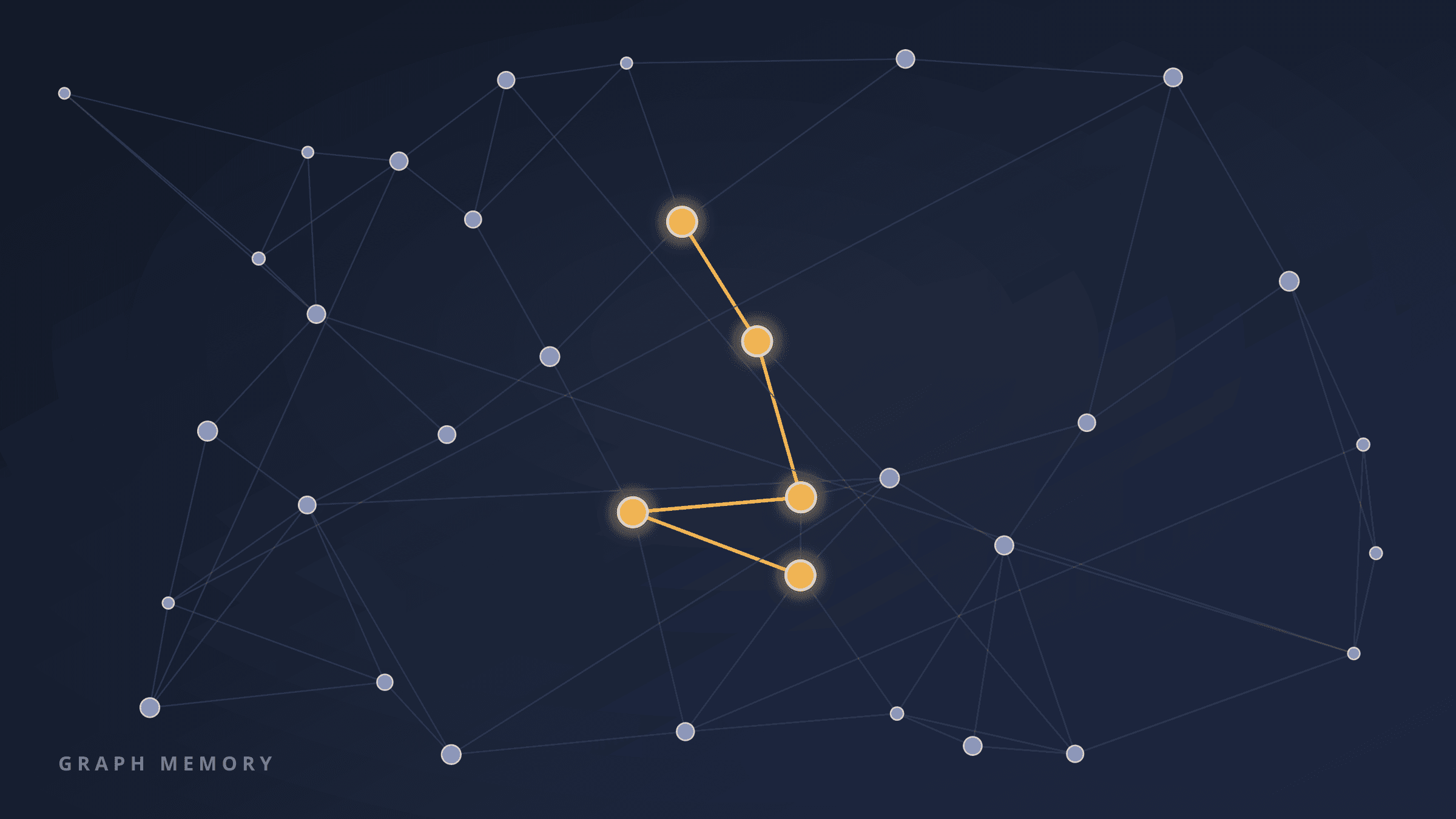
Graph memory represents what an agent knows as nodes and typed edges instead of a flat list of documents. A node might be a fact, a preference, a person, or a project. An edge captures how nodes relate: caused by, contradicts, supersedes, belongs to. Instead of asking "what text looks similar to this query," the agent asks "what's connected to this node, and how." Retrieval becomes traversal, not just search.
This isn't a novel idea in computer science — knowledge graphs have existed for decades — but applying it to conversational agent memory is newer, and it changes what's possible:
- Contradictions become visible. If a new preference conflicts with an old one, the graph structure makes that an explicit edge to resolve, not a silent overwrite.
- Context assembly gets cheaper and more precise. Instead of retrieving the ten most similar chunks and hoping the right one is in there, the agent walks outward from a relevant node to the facts that actually bear on the current task.
- Memory stays legible over time. A graph can be inspected, pruned, and corrected. A vector index of thousands of embeddings can't be reasoned about by a human at all.
A working example: linked memory files
You don't need a graph database to get most of the benefit. One practical pattern — used by Claude Code's own memory system — is deceptively simple: store each piece of memory as a small file with a type (user context, feedback, project state, reference) and let files reference each other with lightweight links, similar to a wiki. A feedback memory about how to run tests can link to the project memory explaining why that convention exists. A user-preference memory can link to the feedback that established it.
That's a graph. The files are nodes; the links are edges. There's no vector index and no embedding model involved — just an index file the agent reads on every session, plus the ability to follow a link when a memory references something it needs more context on. It's crude compared to a proper graph database, but it captures the property that actually matters: memory that knows how its own pieces relate to each other, not just what each piece says in isolation.
Why this matters for agents specifically
The value of graph memory compounds with agent autonomy. A single-turn chatbot barely needs memory at all. An agent that works across many sessions — writing code, tracking a project, learning a user's preferences — accumulates facts that interact with each other constantly. Without structure, that accumulation turns into noise: contradictory instructions, stale context, and retrieval that surfaces the wrong thing at the wrong time because it merely sounds relevant.
Graph-structured memory also makes an important failure mode much easier to catch: staleness. A node that's contradicted by a newer one, or that references a file or function that no longer exists, is a broken edge — something a system can flag and a human can review. A stale entry in a vector store just sits there, indistinguishable from a fresh one until it's confidently retrieved and confidently wrong.
Where this is headed
Expect the distinction between "memory" and "retrieval" to keep sharpening. Retrieval-augmented generation solved the problem of getting relevant text into context. Graph memory is solving a different problem: keeping a coherent, correctable model of what an agent actually knows, so that recall isn't just similar — it's right. For anyone building agents meant to work with someone over time rather than answer one question and forget, that distinction is the whole ballgame.