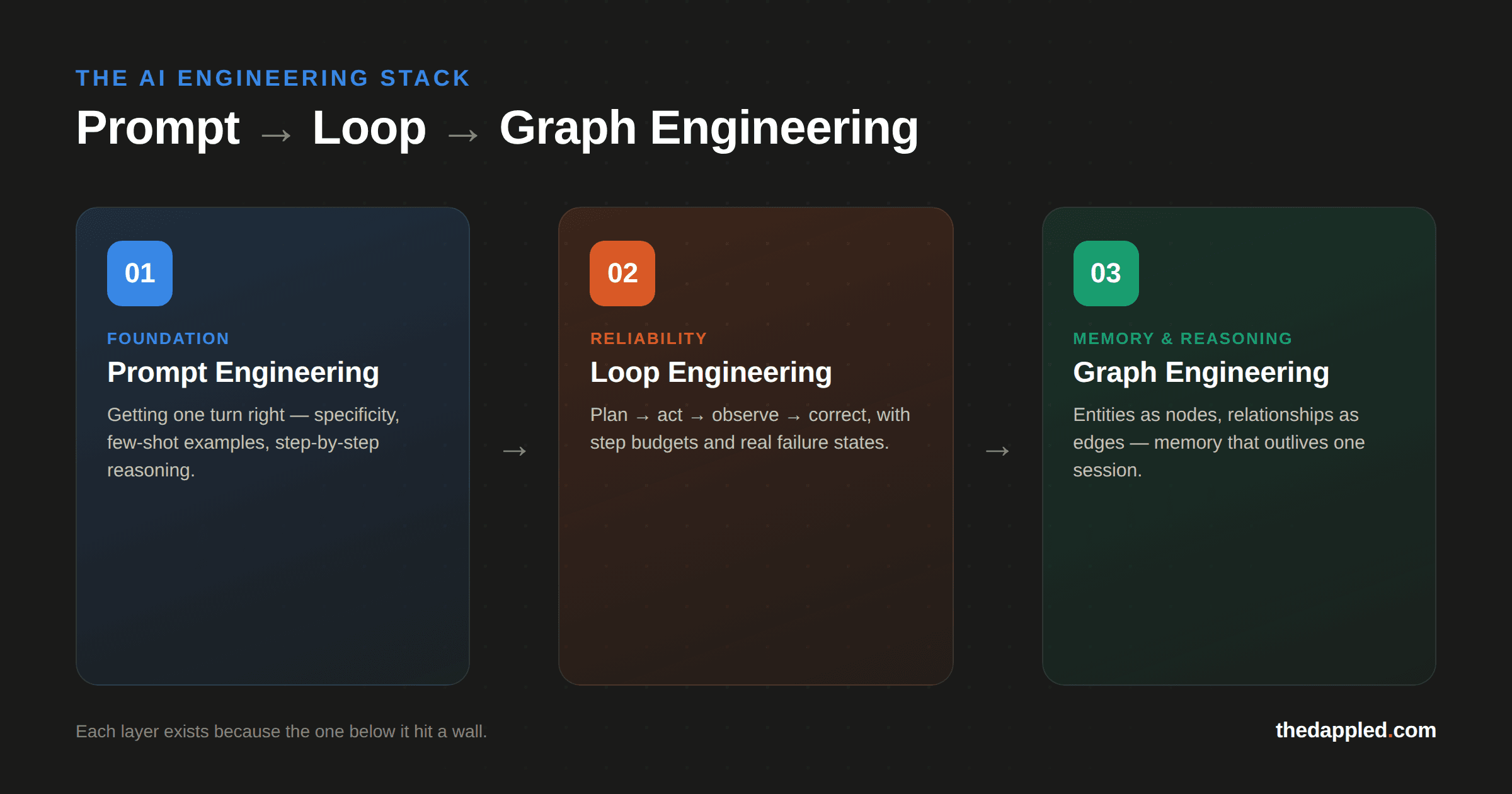
Every roadmap for "learning AI engineering" makes it sound like one skill. It isn't. Across the last two years of building agentic systems, the skill has split into three distinct layers, stacked on top of each other, each one only becoming necessary once the layer below it hit a wall. Prompt engineering, then loop engineering, then graph engineering. Skip a layer and the ceiling you hit isn't subtle — it shows up as an agent that talks well but can't finish a task, or one that finishes tasks but forgets everything the moment the context window fills up.
This is the map of that progression: what each layer is actually for, the specific failure that forces you into the next one, and why the order isn't optional.
Layer 1: Prompt Engineering — The Interface Layer
Prompt engineering is where everyone starts, because it's the only interface a model has. Every capability — writing, planning, reasoning, coding — is reached entirely through the words you give it. Getting specific about the output, using few-shot examples to resolve judgment calls, and asking the model to reason step by step before answering: these close the gap between "an answer" and "the answer you actually needed."
The ceiling shows up fast once a task needs more than one exchange. A single well-crafted prompt can produce a great first draft. It cannot notice that its own output was wrong, fetch a piece of missing information, or retry with a correction. Prompt engineering optimizes one turn. Most real work isn't one turn.
Layer 2: Loop Engineering — Where Reliability Actually Lives
Loop engineering is the layer almost nobody names explicitly, even though it's where most of an agent's actual behavior gets decided. It's the plan → act → observe → correct cycle: the model proposes a step, a tool executes it, the result comes back, and the model decides whether to continue, retry, or change course.
This is a different discipline from prompting because the failure modes are structural, not linguistic:
Step budget exceeded  -> agent loops forever refining an answer nobody asked to refine
No error surface      -> a failed tool call gets silently treated as success
No stop condition     -> "keep trying until it works" becomes an infinite retry storm
No state between steps -> agent re-does step 1 because it forgot it already did step 1
Getting the loop right means deciding, deliberately: how many steps an agent gets before it must stop and report back, what a failed step looks like versus a completed one, and what carries over from one iteration to the next. None of this is solved by a better prompt — it's solved by the control flow around the model. Prompting still matters inside each step, but the loop is what determines whether ten well-prompted steps add up to a finished task or an expensive, confident-sounding failure.
Layer 3: Graph Engineering — Structuring Memory and Reasoning Across Time
Loop engineering solves a task that fits inside one working session. It runs into its own ceiling the moment work spans sessions, or the moment an agent needs to relate facts to each other rather than just recall them. A flat context window treats "the user's deadline is Friday" and "the user mentioned they're on vacation Thursday" as two unrelated strings sitting near each other in a buffer — it has no notion that these two facts are connected until something forces the connection back into view, and it has no way to hold that connection once the window rolls over.
Graph engineering is what replaces that flat buffer with structure: entities as nodes, relationships as typed edges, and retrieval that walks the graph instead of just similarity-matching against a pile of text. This is what lets an agent update a fact instead of accumulating a contradiction, and traverse a relationship — "which project is this ticket blocking, and who owns that project" — instead of hoping both facts happened to land in the same context window at the same time.
The honest caveat: a graph is more machinery than most tasks need. It earns its cost when relationships need to be queried, not just recalled, and when memory has to survive and stay consistent across many separate sessions. Below that bar, loop engineering with well-scoped context is simpler and just as reliable.
Why the Order Isn't Optional
Each layer exists because the one below it has a specific, reproducible failure — not because it's a more advanced skill for its own sake:
- Prompt engineering fails at multi-step tasks: it has no mechanism to check its own work.
- Loop engineering fails at long-horizon memory: it has no structure for how facts relate once the session ends.
- Graph engineering is overkill for anything that fits in a single well-prompted loop.
Learning graph engineering before loop engineering is possible, but it tends to produce systems with an elaborate memory layer wrapped around a control loop that still can't reliably stop, retry, or report failure. The structure looks impressive and the agent still falls over on the boring part.
What This Means If You're Learning This Stack Right Now
Build in the order the failures show up. Get a single prompt to reliably produce the output you actually want. Then wrap it in a loop with an explicit step budget, an explicit definition of failure, and explicit state passed between steps. Only once that loop is trustworthy on its own is it worth asking whether the task needs memory that outlives the loop — and if it does, that's the point where a graph earns its place, not before.